The Traitors Board Game

If you have watched the Traitors on TV then you know this game. Play as a Faithful or Traitor over 4 rounds to gain gold for your personal fund, survive the game and have the most gold by the end to then compete with another player to split the money or betray them and take it all!

Faithful and Traitors will play through 4 rounds of tasks that are set out in 1 of about 4 or 5 scenarios. The faithful are trying to help the task be done to gain gold (points) and stay alive. Traitors have secret objectives they must complete to gain extra points and the ability to remove a faithful at night. 

This game is rather complicated for an adaptation of the tv show to play at home. For a family or casual group of players it will take a while to understand the rules and set up and longer to play. But if you like the Traitors it can be worth it as it is reasonably faithful to the tv shows feeling. 

The problem with this game is it is needlessly complicated for a social deduction game. As a huge fan of Social deduction games, they are meant to have a low bar for entry, simple rules, and straight forward win conditions…so why is the Traitors so complicated? The Traitors Board Game adds extra steps, mechanics, and criteria which muddies the water and dilutes the real point of social deduction.

The thrill of not knowing who is good or bad, who you should trust and who is working against you is all part of much better games like Coup, Werewolf, and even the grandfather of these games Mafia! These games are simple, you have a number of good players, a handful of bad players and after a death in the night, you start to talk and, wait for it, socially deduce who might be bad and who is good. The best part is when the evil player gets the good players on side to destroy their own and comes out on top through true deception.

The Traitors board game is a fine introduction to these games and if you like the show, it would be a fun time. But if you like the show and like the idea of social deduction, find one of the games I mentioned above as these will give you much more than this game.

5 Second Rule: The fast and Chaotic Trivia Game

Do you think you know a lot of footballers? Musicians? Countries with coastlines? Do you want to put that knowledge to the test? Then pick up this game.

5 Second Rule is as simple as the name suggests, you have 5 seconds… to do what you ask? Well to say the name of 6 rappers, or name 7 kitchen appliances. What makes this game chaotic is the timing tower, a tall spiral tower with a ball bearing that will noisily whirl down in, you guessed it, 5 seconds! 

As it stands that sounds easy but the difficulty comes from the group dynamic. A players turn starts with someone drawing them a card and reading the prompt and then flipping the tower to start the noisy timer. But, pay attention as if the first player can’t do it they flip the tower and the person to their left must try and meet the prompt. The difficulty, fun, and chaos ensues… Because you cannot use any of the previous players’ guesses.

Play continues around the group until someone gets it or it reaches the starting play in that case the tower has won! When we played we tracked the tower’s points as well as our own for fun – it did annoyingly well! 

This is a fast paced party game that is suitable for most ages and is a fun exploration of what random trivia you can pull from the deep parts of your memory. Your mum might surprise you with her knowledge of Spanish kings, or your grandma might weirdly know the films list in the top grossing films list.

If you are a fan of party games at family gatherings or with friends I highly recommend grabbing this game as it is quick and a wild time – it can really get everyone up on their feet screaming and shouting or saying something random that gets the whole group laughing.

Murdle: A Quirky Mystery Solving Game

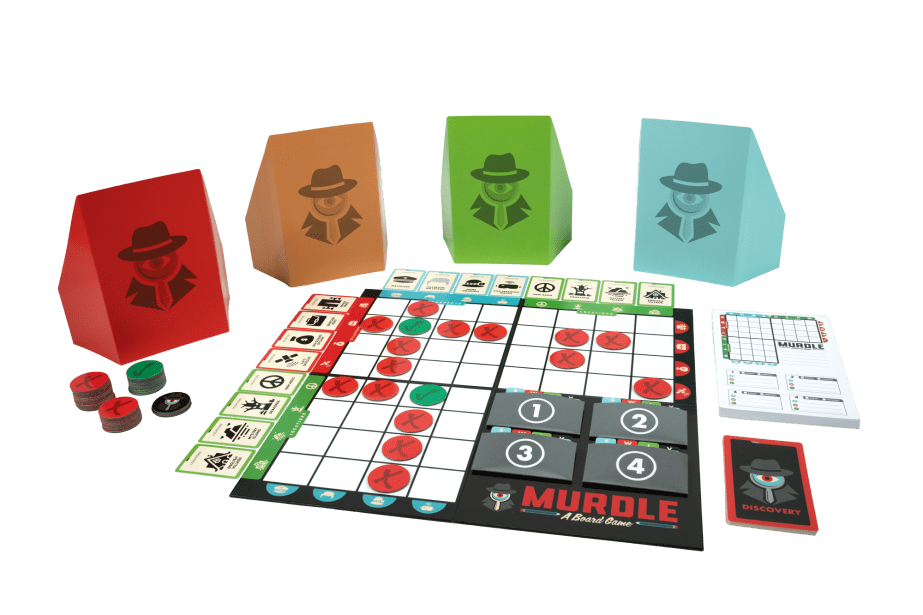
Murdle is an interesting blend of Mastermind and Cluedo, you and your fellow players compete to figure out which of the 4 suspects is the guilty party. The twist, you all learn certain starting information and then must carefully reveal information to learn more but try to not give too much away to the other detectives!

You take turns to do one of two things, tell every something that is not true or something that is. Each has their own rules but they all lead to taking one of the suspect files and looking at a new piece of information. While you do this, your opponents can try to deduce what this information means to them.

All your information is collected on the central grid for the game that all players can see, this grid shows the suspects, potential weapons, and locations. Using large crosses and ticks in columns and rows the game highlights for the crime what, where, and by who. As the game progresses all players will start to see more information and be able to make a final deduction but be careful, get it wrong and you are out for the rest of the game!

We found this game to be a fun quick game with experienced players and would probably take longer for more casual players. The instructions are simple and clear. The only problem we found was if one player gets lucky early on and learns who the guilty person is, they can quickly win before anyone else has a chance to make a deduction. We felt as a group it should be harder to learn who the guilty party is or have more suspects – this would extend the game but could make for a fun series of Sherlock Holmes moments for the players.

Overall we enjoyed the game but for experienced board gamers who play a lot of social deduction games this is a nice and quick game to play between bigger and more complex games. It left, for us at least, a little bit of a lackluster feeling at the end. 

For a family or casual group, this game is a great introduction to social dedication and information gathering games and I would recommend trying this out.

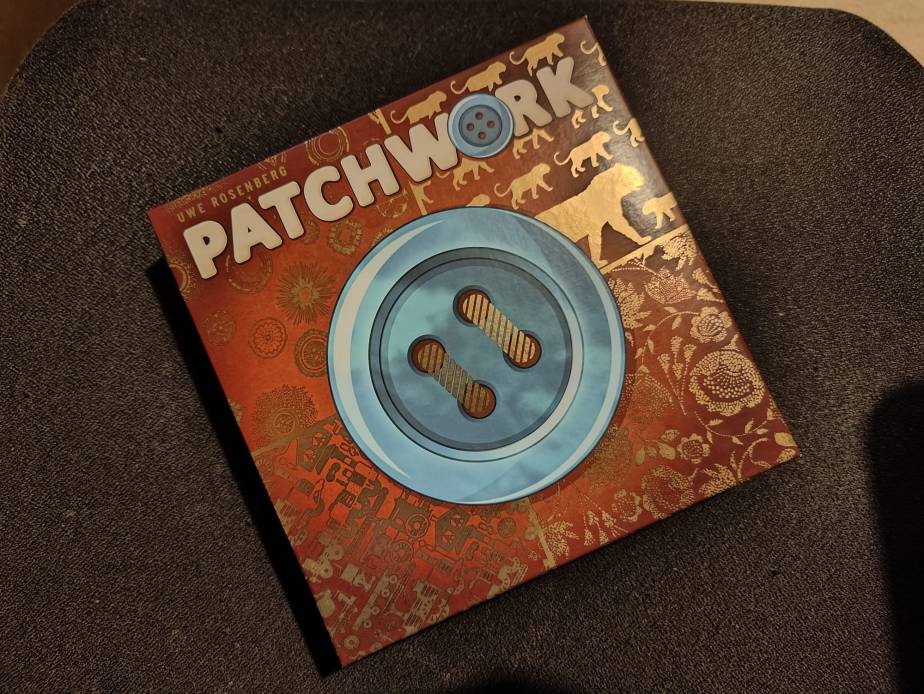
Patchwork: A Cosy Game About Making a Quilt

We sat down to play Patchwork expecting a simple tile placement game but found a fun and engaging puzzle of creation. This game has you softly competing with another player to build a quilt with random sized tiles on your own grid. The satisfaction of placing just the right piece to fill a gap… amazing!

In Patchwork, you take turns but not in the conventional manner. The player behind on the time board plays, so if you stay behind your opponent you can take multiple turns in a row. On your turn you will pick from 3 different shaped quilt tiles, all with beautiful patterns. Then move a sweet little sewing machine token to replace the taken token and now your choice of tokens changes, giving each turn a new challenge to get just the right tile, or work with what the fate of the game gives you.

So what’s the catch for placing tiles? Each one costs a certain amount to play and takes you time to add to your quilt, which will have you and your opponent leapfrogging across the time board, staring down the other player as their hand hovers over the piece you want, and looking at that all too expensive piece that would fit perfectly but you don’t have the buttons for! 

This game is quick, engaging, and has a cozy feeling as you build your quilt alongside your opponent. Patchwork really nails the pace, simplicity of its rules but gives so much replay value – my wife immediately wanted to play this with her mum when she finished. It is a game for any level of boardgamer. 

The one part we found a little dissatisfying was the scoring at the end but this may have been due to our gung ho way of playing! We found the -2 points for blank spaces harsh and it led to one of us getting negative points. I would have it only remove 1 point or -2 per a certain amount of blank spaces to give a bit more of a good feeling at scoring. But we enjoyed the journey of the game and look forward to playing again.

Patchwork is a great game to pick up for a couple or to play while catching up with a friend. It requires just enough attention that you can play, chat, and enjoy! The satisfaction of the quilt you can build and fitting that perfect piece will have you wanting to play again and again to see what form of Patchwork you make next time!

Available from £22.99 at: https://www.johnlewis.com/asmodee-patchwork-game/p113011033?s_ppc=2dx_mixed_home_BAU&tmad=c&tmcampid=2&gclsrc=aw.ds&gad_source=1&gbraid=0AAAAAD2el1xsnMBLxQENgyUI88JTxb41h&gclid=CjwKCAiArKW-BhAzEiwAZhWsINM5utKi0PX2I-yjEyV0lX-GOD0EUxaOQ40v7LuICNRP09C0lsfSXhoCaHAQAvD_BwE

Spot the Intro

Disclaimer: We received this product free of charge for the purpose of this review and all thoughts and opinions are our own.

Christmas is a time when the whole family gets together and sitting down to play a board game after lunch is now a favourite family tradition. Music games are great to play when you have a mix of ages and Spot the Intro from Cheatwell Games is bound to get everyone reminiscing about the music of their youth and all those long forgotten top ten hits that we all know and love.

The game features music from the last six decades with the aim being to guess songs from a 10 second intro and be the first to reach the finish. There are 480 double sided cards in the box giving you 960 tracks to play and we found it quite addictive so it will certainly keep everyone occupied over the Christmas period. Unlike older music quiz games that used a CD or DVD to play the music, this game has QR codes on the cards to scan with your phone, taking you to a Spot the Intro page where you can play the songs via Amazon, Apple, Spotify or YouTube.

After listening to the intro, the team have to name the song correctly to get one point with an additional point given for naming the artist. With any correct answer there is a bonus question with another point available for a correct answer. Once the questions have been answered the team then moves their counter by the number of correct answers.

The game is great fun although it’s a bit fiddly scanning the codes so that’s definitely a job for the teenagers rather than Granny!  

Spot The Intro is a great game for music lovers and works really well as a team game, especially with mixed ages. It’s a great game to play with family and friends and with Christmas round the corner, it would make a great gift that also doubles up as the afternoon or evening’s entertainment.

RRP £25.83 available from Amazon

5 Second Rule Uncensored Round 2

Disclaimer: We received this product free of charge for the purpose of this review but all thoughts and opinions are our own.

Galentine’s Day is a new concept and was started back in 2010 on the American comedy television series Parks and Recreation. Celebrated on 13th February it is a day to celebrate important female friendships and is the perfect excuse to get your girlfriends together for the evening.

If you are planning a get together at home this Galentine’s Day then the 5 Second Rule Uncensored Round 2 from Playmonster Games is bound to give you a good giggle. The game is a spin-off of the popular family game but in this version the cards contain some questions with an adult content and comes with a recommended age of 17+

Inside the box are:

  • 150 doubled-sided question cards
  • Twisted timer – which makes a silly noise whenever it’s flipped. 
  • Rules

The game is really easy to set up, you simply choose a question card from the box, turn the timer and you’re ready to play. You have 5 seconds to name 3 things on the card – which sounds easier than it actually is so you do have to think quickly. With questions like “Name 3 things you nibble”, “Name 3 things you can do with whipped cream” and “Point to 3 places sand gets stuck after a trip to the beach” it’s not a game for people who are easily embarrassed or prudish. There are some quite risqué questions in the box too so it’s probably best to play it with people you know very well and not your Mum!

To score a point you need to name 3 items and you then keep the card, making keeping track of the points nice and easy. If the player can’t name 3 items, play passes onto the next player however, they can’t use any of the answers that have already been used, making it quite tricky.  

If no one can get three answers and all the players have had a turn, the original person is awarded the point by default. The player to the right of the starting player then picks a card and it starts again until the agreed upon number of rounds has finished.

We had a great night playing 5 Second Rule Uncensored, it is a great adult party game that quickly gets everyone laughing.

RRP £14.99 from the Playmonster website

Triggle Family Board Game

Disclaimer – We received this item free for the purpose of this review/feature but all words and opinions are our own.

Families are always looking for more wholesome ways to connect and have fun, so Tomy’s board game Triggle is a gem for the winter months. Based on 2-4 players (but you could play in teams) it is aimed at 8 years and upwards and has a remarkably simple objective; to create triangles.

The starting board consists of pegs arranged in a geometric pattern. Each player chooses one of the colours of pegs (there are 21 pegs for each player) and the elastic bands are divided out between everyone playing. Taking it in turns, each player add one rubber band to the board, suspending it between any two posts in any direction. The only ‘rules’ are that the line created by the band must be straight, and it must stretch across 4 post only and touching at least one other rubber band. 

Once a player creates a triangle with their rubber band, they can claim it as their own by placing their coloured peg inside it. A triangle consists of only one single space.

The game ends whenever there are no spaces left on the board to claim, or one of the players uses up all their pegs.  An alternative to the full game is for each player to have a set amount of rubber bands (for instance, 10 or 20) and the players play until there are no more bands left. Whoever has the most pegs placed on the board is the winner.

This is a remarkably easy game to follow and learn the rules for, and can keep the whole family entertained. We found that playing with just two, and especially two adults or older children was exceptionally easy and allowed for conversation throughout. There was no need to remember where you were in the game, so it was easy to talk, or walk away and come back after dinner if you needed to. It also doesn’t last for hours and hours where you feel compelled to complete the game. It also didn’t require point scoring or writing anything down as you can just count up the number of pegs visible, and there’s no need for remembering characters or complicated rules!

If you are in a group who don’t speak English or have limited vocabulary, this is a great mind teaser puzzle, and if you lose the rubber bands, they can easily be replaced. Instead of using the pegs, you can use any other type of counter from another game, so there’s longevity too.  I found that after a while, some of the younger children (under 12 years old or so) were able to make up new games of their own, or liked making patterns in the board after the game had finished, so there was endless entertainment to be had over the school holidays.

Triggle isn’t really a game you grow out of and can be picked up by anyone. It’s definitely a “thumbs up” from us as a family game.

Available from £19.50 at Amazon: https://www.amazon.co.uk/Fat-Brain-Preschool-Educational-Suitable/dp/B08SRF4FKJ/ref=sr_1_1_sspa?crid=2T4AYCESTM577&keywords=triggle+board+game&qid=1672763459&sprefix=triggle+board+game%2Caps%2C63&sr=8-1-spons&sp_csd=d2lkZ2V0TmFtZT1zcF9hdGY&psc=1